Emergency & Storm Tree Removal in Valley Stream
Most storm calls start the same way: you heard it before you saw it. A crack at two in the morning, then something very heavy settling onto the garage roof. Here's the order to do things in, and the two calls to make before you call anyone with a chainsaw.
First five minutes
- Wires down or touching the tree: stay away and call PSEG Long Island at 1-800-490-0075. Treat every wire as live. Nobody touches a tree that's in contact with a line until PSEG has made it safe. Not us, not you.
- Tree on the house: get everyone out from under the damaged section. If the ceiling is sagging or you can see sky, that room's closed until someone has looked at the structure.
- Photograph everything before anything moves. Wide shots, close shots, the date on your phone. Your adjuster will ask for these, and they're gone the moment the first cut gets made.
- Then call us. Tell us what it's on: the house, a car, the wires, or the ground. That's how we sort the queue.
What storms do to Valley Stream
The South Shore gets hit from two directions. Hurricane season peaks August through October. Sandy pushed four feet of tide into Mill Brook in 2012, and Tropical Storm Isaias in August 2020 put more than a hundred trees and limbs down across Valley Stream with barely a fifth of an inch of rain, just seventy-mile-an-hour gusts on a leafed-out canopy. Then the nor'easters run October through April: the March 2018 pair knocked out tens of thousands of PSEG customers on wind alone.
You can almost call the failures in advance. Seventy-year-old Norway and silver maples with shallow roots in saturated sandy soil. Bradford pears splitting at the trunk. And the Halloween 2011 pattern nobody plans for: wet snow on trees that still have their leaves, snapping limbs that would've shrugged off a January storm. If you've got a big tree over the house and haven't had it looked at, a pre-season prune is the cheap line on this page.
What the job looks like
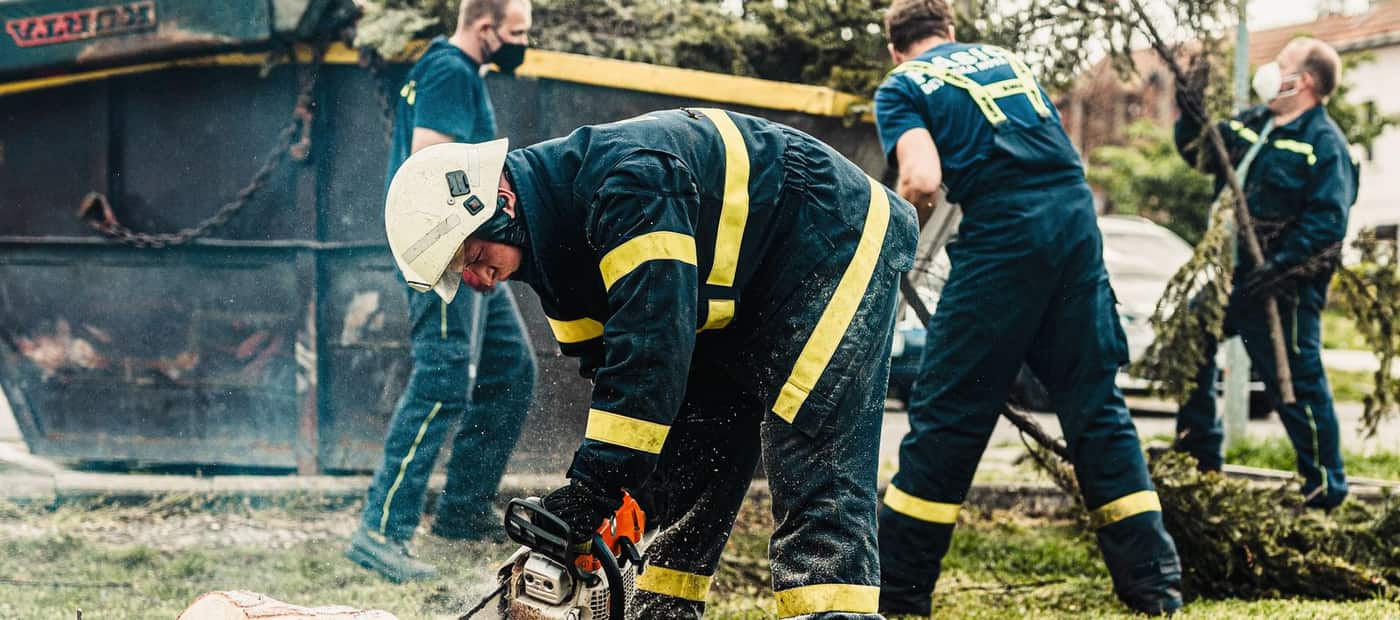
Emergency work is removal work with the order flipped: we make the dangerous part safe first, then take the rest down properly. A tree on a roof comes off in pieces with the weight controlled the whole way, because letting it roll does more damage than the storm did. A trunk across a driveway gets cut enough to get you out, then cleared. Hangers, the limbs cracked and caught in the canopy waiting for the next gust, come down before they pick their own moment. Then chipping and haul-away, which after a storm is often the biggest part of the job. When the chipper finally goes quiet, the street starts to feel normal again.
The insurance math
Two things decide whether a claim is worth filing. The tree has to have hit something covered (a structure, not the lawn), and the debris-removal line on most policies is capped around $500 per tree, well under what a big removal costs on Long Island. If a hurricane was declared, Nassau policies often carry a percentage hurricane deductible on top. So a small limb on the lawn is an out-of-pocket job, no claim. A maple through the garage roof is a claim, and the photos you took in the first five minutes are what make it go smoothly. We write up the damage and the removal separately so the adjuster can read it.
About the trucks that show up after the storm
After a big blow, crews follow the weather into Nassau. Some are fine. Be careful with the rest: no local address, no Nassau County license number, pressure to sign something in the driveway, and a price that somehow lands right where the insurance pays out. After Sandy, homeowners here got bills north of ten thousand dollars for a single oak, with the stump and the debris left behind. Even in an emergency you can ask for a written, itemized number from someone who'll still answer the phone next spring.
Storm questions
Does homeowners insurance pay for the tree removal?
Usually only if the tree hit something covered (the house, garage, shed, or fence), and even then the debris-removal line is commonly capped around $500 per tree, which is less than a Long Island removal costs. A tree that just fell on the lawn is generally on you. Either way, photograph everything before it moves.
My neighbor's tree fell on my garage. Who pays?
In New York, if the tree was healthy and a storm took it down, that's an act of God. Your own policy covers your garage and the neighbor owes nothing. It only flips to the neighbor if they knew, or should have known, the tree was dead or dangerous. Dated photos of a visibly dead tree, sent to the owner in writing before it falls, are what make that case.
How fast can you get here after a storm?
Trees on houses and wires first, driveways and access second, everything else after. When a storm like Isaias puts a hundred-plus trees down in Valley Stream alone, that queue is real, and we'll tell you where you stand in it. Storm pricing gets written up like any other job. There's no after-storm markup.
Tree down, hanging, or on something it shouldn't be on? Call (516) 619-3667 and tell us which. Not an emergency, just a big tree you're worried about? Start with planned removal instead. It's cheaper in daylight.